
BlogArtificial Intelligence
Paperclip for AI Agent Teams: When SMEs Need a Control Plane
By Dominik Pototschnig16 min

In this article
Paperclip does not turn AI agents into employees. But it aims to turn scattered agents into an operation that can be managed—with responsibilities, budgets, approvals and logs.
For SMEs, the more important question is therefore not how many agents they can “hire”. It is when coordinating them becomes an operational problem in its own right.
“AI company” and “AI employee” are product metaphors here: Paperclip does not create a company, assume legal responsibility or automatically make agent outputs correct. Software, access rights and accountability remain with the operator.
Short answer: Paperclip is neither a language model nor a replacement for n8n. It is a control plane that coordinates existing AI agents through roles, tasks, budgets, approvals and activity data. It becomes useful mainly when several agents and their handoffs already create measurable time, risk or cost. For one agent or a stable if-then process, it is usually more infrastructure than solution.
Product, policy and source status: 15 September 2026. Verify volatile information again before implementation.
What Paperclip actually is
Paperclip describes itself as an orchestration platform for autonomous companies. For a robust decision, a more sober category is more useful: a central management and control layer (control plane) for multiple AI agents.
The system does not perform the underlying model work itself. Instead, it connects agent runtimes, organises work and provides a shared operating and control layer. According to its product definition, Paperclip is explicitly not a chatbot, agent framework, prompt manager, single-agent assistant or visual workflow builder.
In Paperclip, a “Company” is an organisational workspace. According to the core-concepts documentation, it groups a company goal, agents, hierarchy, projects, tasks and budget. Agents report through an organisational structure; at the top is a CEO agent that remains subordinate to the human board.
In simplified terms, day-to-day work follows this sequence:
- A person defines the goal, projects and roles.
- Work is created as issues or tasks and assigned to agents.
- A connection—called an “adapter” in Paperclip—starts the appropriate agent runtime.
- A work cycle—labelled a “heartbeat run” in the interface—handles the assignment.
- Status, costs and activity flow back into the shared interface.
- Certain decisions or overruns can trigger human approval.
That is considerably more than a loose collection of prompts. But it is still not a guarantee of good work. Paperclip can structure responsibilities and control points; whether an agent understands the content, uses a tool correctly or recognises a business risk remains a separate question.
Which agent runtimes can Paperclip connect?
The adapter overview listed, as of the source date, Claude Code, Codex, Gemini CLI, Cursor, OpenCode, Pi, Hermes, Grok and Kimi, among others. Paperclip does not replace these runtimes; it starts and coordinates them.
Important: such a list does not mean every connection has the same maturity, functionality or interface. Status notes vary. The newer Connections v3 and Apps are also experimental according to the official documentation: there is no compatibility guarantee, the catalogue is early, and setup flows are still incomplete. The documentation describes the goal of a finished one-click app experience—it does not describe a fully delivered current state.
One agent, n8n, project management or Paperclip?
The four approaches address different primary problems. This matrix is therefore not a ranking, but Wogenfels’ editorial categorisation for an initial decision.
| Starting situation | Suitable starting point | What this solves first | Typical limit |
|---|---|---|---|
| An open task needs to be handled with tools | A single AI agent | Carry out the specific work | Roles, handoffs and the overall budget across multiple agents remain outside |
| A process can be clearly described in advance | Typical starting point: workflow-first, e.g. n8n | Often solves repeatable steps and defined handoffs first | Open sub-tasks may need a bounded agent step where appropriate |
| People and teams need a task overview | Typical starting point: existing project management | Often solves responsibility, deadline and status first | Agent control and its runtimes remain a separate architecture topic |
| Several agents work with handoffs, costs and approvals | A Paperclip pilot | Coordinate agents as a shared operating model | An additional platform, security surface and operational responsibility |
Paperclip is therefore not categorically an “n8n alternative”. n8n starts workflow-first with a defined control graph; Paperclip starts with an agent organisation. In many real architectures, both layers can make sense side by side: a workflow provides the fixed outer frame, agents handle tightly bounded open steps, and a control plane coordinates several such agents.
If you are still working out whether your process needs an agent at all, start with the article “Hermes Agent or n8n?”. Paperclip only becomes relevant at the next level of complexity.
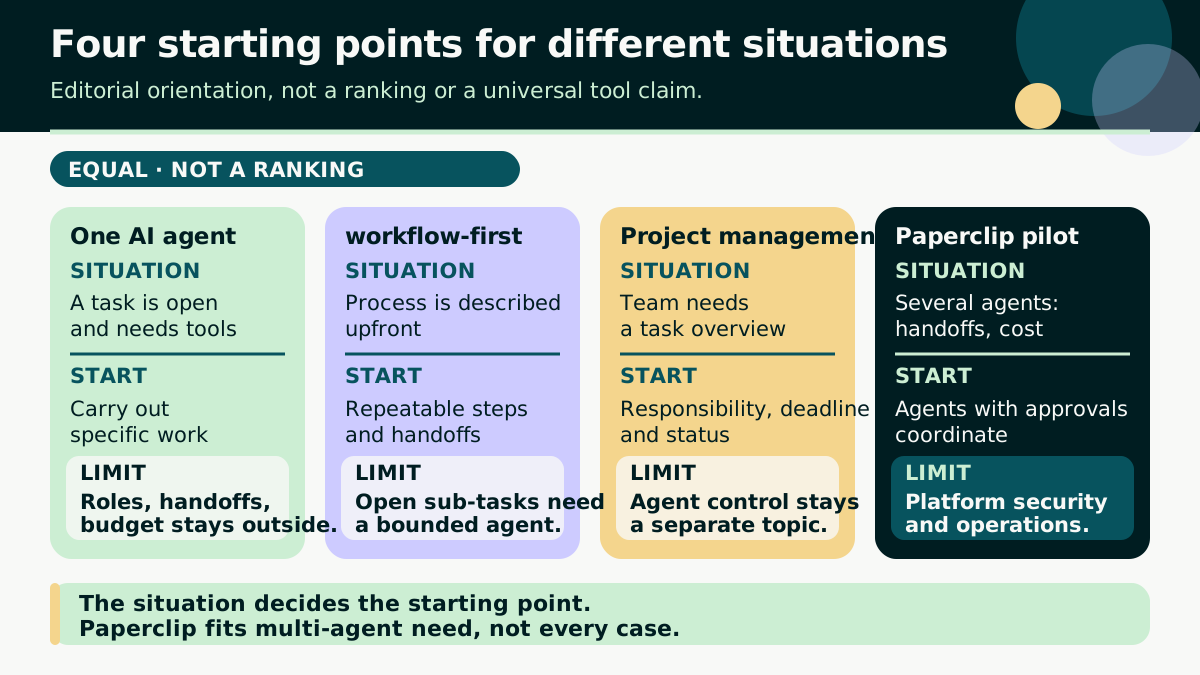
Wogenfels’ classification by the operating problem that must be solved first; not a ranking or a universal tool claim.
Where Paperclip can deliver real operational value
1. A shared view of multiple agents
Once different agents research, develop, review or prepare content, coordination work emerges. Who is working on what? Which task is blocked? Which run belongs to which result? According to the documented core concepts, Paperclip connects agents, projects, tasks and work runs in a shared structure. That can make scattered terminal sessions and individual logs easier to follow.
2. Responsibilities instead of an all-powerful universal agent
The documented organisational model permits separate roles and reporting lines. This has organisational value where rights and tasks are genuinely designed differently. A research agent does not need booking permissions; a coding agent does not automatically need access to customer data; a reviewer should not approve the same changes unchecked.
Hierarchy alone does not enforce this separation, however. Roles in the org chart must match technical identities, least-privilege permissions and separate execution environments.
3. Making budgets visible and stopping runs
Paperclip documents budgets at company and agent level. This includes warnings, a stop on reaching the limit and an approval path for budget overruns. The cost view can break down usage by agent, model, provider, project or task.
That is useful—but it is not a guaranteed ceiling on your total bill. The cost API explicitly supports usage that has not yet been priced (unpriced). Provider invoices remain authoritative for final reconciliation; subscription costs may only be estimated until then. Hosting, storage, tools, sandboxes and internal working time are additional factors.
A budget stop means Paperclip stops based on usage captured by Paperclip. It does not mean that no external provider can charge costs afterwards.
4. Approvals and activity in one place
The approval documentation mentions strategy or hiring decisions, new agents and budget overrides, among other items. Plan and task reviews can also be represented. The activity/audit feed associates events with agents, runs and responsible users, among other things, and can be exported as CSV.
That improves traceability. It does not prove cryptographic immutability or regulatory auditability. Nor does it mean every external action is automatically approved in advance.
For tool calls, Paperclip describes a Tool Gateway that can allow, block, submit actions for approval and log them. As of the source date, this interface is experimental and disabled by default. The decisive architecture rule is therefore:
Governance works reliably only where identity, permission and action genuinely pass through the controlled path.
An agent started locally with direct operating-system or API permissions is not made secure by an attractive org chart alone.
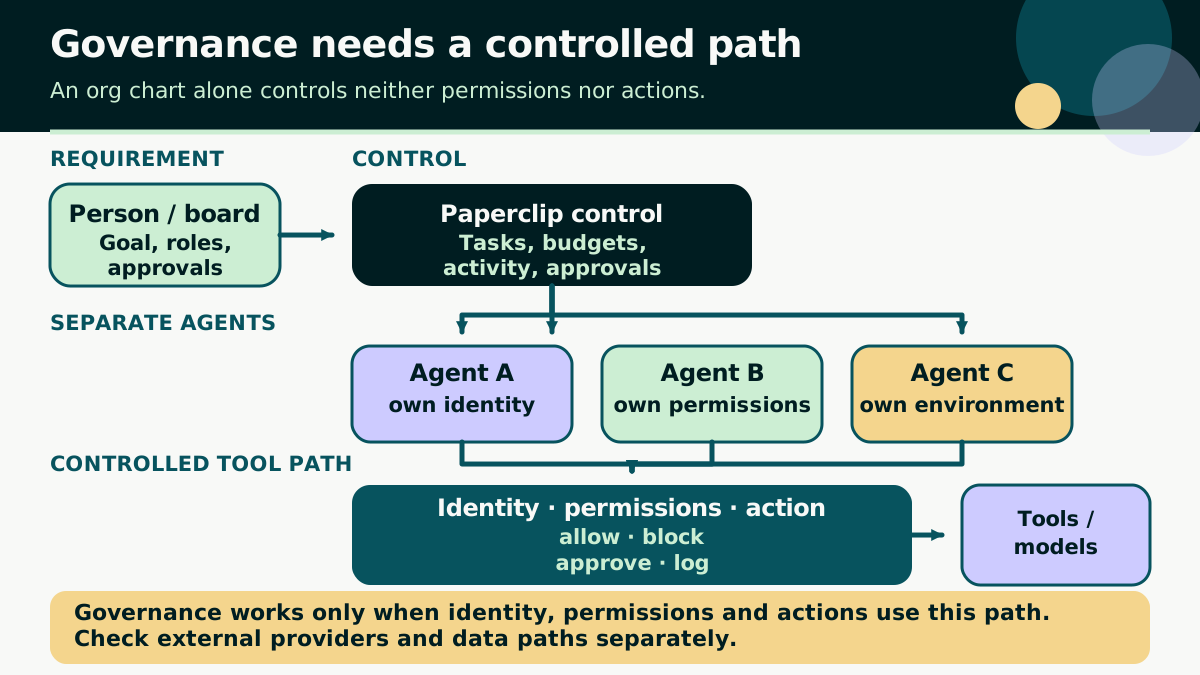
Architecture principle for a controlled pilot: external providers and data paths remain separate review points.
What Paperclip costs—and why there is no credible single figure
According to the licence file, the code is MIT-licensed. A self-hosted installation therefore does not incur a Paperclip open-source licence fee. “Free” would still be the wrong conclusion.
On 15 September 2026, the website offered a local start and a cloud waitlist. No reliable public cloud price list was found in the official pages reviewed. The dollar ranges mentioned in the introductory documentation are examples of possible model and agent usage—not Paperclip prices or an offer.
For an SME calculation, at least these six cost blocks need to use the same volume assumptions:
| Cost block | What you should capture |
|---|---|
| Introduction | Process design, roles, integration, testing, migration and training |
| Platform operations | Host, database, storage, backups, monitoring and updates |
| Models | Tokens, runtimes, different providers and usage not yet priced |
| Agents and tools | Runtime subscriptions, APIs, browsers, sandboxes and other services |
| Human work | Approvals, quality assurance, rework and incident handling |
| Security and compliance | Access design, isolation, contracts, documentation and regular review |
Compare this total with the current process, not with zero. A pilot is economical when, at comparable quality and acceptable risk, it saves or enables more than introduction and operation cost. Whether that succeeds is a measurement question—not a product property.
Self-hosted is more controllable—but not automatically GDPR-compliant
Paperclip can be self-hosted. The deployment documentation distinguishes a local trusted mode for localhost without login, an authenticated private deployment such as an internal network or VPN, and an authenticated public deployment with stricter checks.
For a quick local start, Paperclip uses embedded PostgreSQL and local file storage by default. External PostgreSQL and S3-compatible storage options are documented for shared or production-adjacent setups.
This creates control over Paperclip’s data storage. But it answers only part of the data path. The agent may still call a remote model, search API, browser, MCP server, messaging system or another tool. Data can therefore reach external recipients despite a local Paperclip instance.
For every option—local, private cloud or hosted service—you should therefore document the full data path:
- Which personal or confidential data reaches Paperclip?
- Which content goes to which primary or auxiliary model?
- Which tools and connected accounts can read, alter or send data?
- Who is the operator, controller and, where applicable, processor?
- Which contracts, storage locations, retention periods and safeguards apply?
- Which telemetry is active, and how is it disabled or limited?
- Which logs are needed for evidence and troubleshooting—and which content does not belong in them?
Telemetry also belongs in the review. The README describes enabled-by-default, optional OSS telemetry. According to the vendor, it should not include prompts, ticket contents, file paths, secrets or personal data. That statement is a vendor description, not an independent privacy audit.
For the hosted service, the Privacy Policy names account, usage, telemetry, device/technical and connection data, service providers used, and possible processing or transfers to the United States. The Terms distinguish the hosted service from the MIT code and contain a functional licence for submitted content; according to the terms, detailed opt-in telemetry may be used to improve machine-learning systems.
In the public primary sources examined as of the source date, no public data processing agreement (DPA), public subprocessor list, fixed EU data-residency commitment or SOC 2 or ISO certificate was found. This does not prove that such documents are unavailable on request. It means they must be specifically requested and reviewed before a hosted pilot.
The article “Is local AI the only GDPR-compliant option?” explains the broader architectural decision.
This assessment is general guidance, not legal advice. The specific processing, allocation of roles, legal basis, contracts and safeguards must be assessed in each case.
The often-overlooked security question: where do agents actually run?
The execution-environment documentation is clear: by default, agent runs execute on the Paperclip host. Alternative targets via SSH or sandbox providers can be assigned, but as of the source date they are experimental features.
In Paperclip, “experimental” means more than a small beta label. The official definition says: opt-in, no compatibility guarantee, may change or be removed without notice, and not recommended for critical production workflows.
For an SME, the practical security boundary follows from this: anyone giving an agent terminal, file, network or API permissions must limit the potential damage of erroneous access—the “blast radius”—as though the agent could choose an incorrect or manipulated next step. Least privilege, separate technical identities and suitable isolation matter more than the role name in the dashboard.
What the published advisories say—and what they do not
Paperclip publishes a Security Policy and Security Advisories. Two specific advisories document unauthenticated remote code execution and OS command injection, respectively, in versions before 2026.416.0; both name 2026.416.0 as the fixed version.
This is not evidence that the current version is insecure. Conversely, a current version number is not evidence of secure operation. The right conclusion is more sober:
- define and pin a supported current version,
- monitor advisories and release notes,
- test updates in a test environment first,
- keep agent permissions and network paths to a minimum,
- actually test backup, restore and shutdown,
- do not leave critical external impact to an uncontrolled agent run.
The rapid release cadence and several experimental interfaces point to an active but young product. That can appeal to controlled early-adopter pilots. For business-critical standard operations, it also raises the review and maintenance effort.
Access keys: a sound approach with one important gap
Paperclip documents a built-in access-key store called local_encrypted. A local master key protects stored values; references to them can be used in agent configurations. A strict mode rejects certain sensitive environment variables when stored as plain text rather than as a key reference.
The same documentation names an important exception, however: config.llm.apiKey is currently a plain-text field and does not support secret_ref. For consistent secret hygiene, the documentation recommends leaving this field empty and binding API keys per agent adapter through secret references.
For external secret stores, AWS Secrets Manager is described as active today. According to the documentation, GCP Secret Manager and HashiCorp Vault are stored only as draft metadata. Here, too, a visible provider name is not yet a ready-to-use integration.
A pilot should therefore follow these rules:
- no access keys in prompts, tickets or logs,
- enable strict secret mode outside a purely local test instance,
- leave
config.llm.apiKeyempty, - separate keys by agent and purpose,
- test rotation and revocation,
- limit host access to the master key.
The 9-point SME pilot check
Paperclip should not start with “We are building an autonomous company”. A good pilot answers nine narrower questions:
- Multi-agent need: Are there at least two clearly separate agent roles and real handoffs—or is one agent enough?
- Bounded process: Is the use case measurable, reversible and subject to human review before external impact?
- Data path: Are data categories, models, tools, recipients, storage locations and contract questions documented?
- Deployment: Has it been consciously decided whether the instance runs locally, privately with authentication or publicly?
- Blast radius: Are host, files, network, systems and technical identities minimally privileged and suitably isolated?
- Access keys: Are keys referenced, separated, rotated and not stored in the plain-text
config.llm.apiKeyfield? - Cost reconciliation: Are Paperclip values regularly reconciled with provider invoices and external costs limited separately?
- Approvals: For every critical action, is it clear who reviews it—and does the action technically pass through the controlled path?
- Operations and exit: Is there version pinning, a patch process, a backup/restore test, export and safe shutdown?
Rate each point met, open or not relevant—with justification. A pilot goes live only when no security, data-protection or business-critical point remains unanswered.
A decision in three minutes
The 9-point check contains the full review. For an initial selection, three clear signals in each direction are enough.
Paperclip is worth a pilot when …
- several already-tested agents have genuine roles and handoffs,
- coordination, blockers or costs are not sufficiently visible today,
- technical permissions, human approvals and ongoing operations can be organised responsibly.
Start simpler when …
- one agent or a fully describable process is sufficient,
- existing project management already solves the real coordination problem,
- productive access cannot yet be kept to the minimum required.
Stop before live use when …
- external actions bypass the approval path or the data path remains unclear,
- cost figures are treated as a guaranteed total-cost ceiling, or broad permissions exist without suitable isolation,
- nobody is responsible for updates, incidents and safe shutdown.
Conclusion: prove the agents first, then build their “company”
Paperclip addresses a real problem: several AI agents eventually need more than separate chats, terminal windows and loose tickets. Roles, tasks, budgets, approvals and activity data in a shared control plane can become valuable then.
But the benefit does not begin with installation. It begins where several agents are already handling an economically viable, tightly bounded process—and where coordinating them is becoming a measurable burden.
For Austrian SMEs, based on the 2026 source status, Paperclip is therefore primarily an early-adopter tool for controlled pilots. Self-hosting, the MIT licence and governance features are strong arguments. At the same time, experimental integrations, default execution on the host, rapid product development and open hosted-service contract questions require experienced operations.
The sensible order is:
- prove a bounded agent process in business and economic terms,
- document the data, access-rights and cost paths,
- test Paperclip as a control plane only once there is a genuine multi-agent problem,
- keep critical external impact limited by people and technology until acceptance is robust.
If you would like to scope such a pilot independently of product marketing, we can clarify the process, metrics and control points together. Get in touch.
Sources and further primary documentation
All sources were checked directly on 15 September 2026. As of that date, v2026.831.1, published on 2 September 2026, was the latest stable GitHub release in the open release list. The visible rapid release cadence is a snapshot; verify volatile information again before implementation.
- What is Paperclip?
- Core concepts and organisational model
- Official GitHub repository and README
- MIT licence
- Adapter overview
- Deployment modes
- Costs and budgets
- Cost API and usage not yet priced
- Approvals
- Tool Gateway
- Activity/audit feed
- Secrets
- Experimental features
- Connections v3 and Apps
- Privacy Policy
- Terms
- GitHub Releases
- Security Policy
- Security Advisories
- Paperclip AI
- AI agents
- AI company
- Self-hosted
- AI governance
More articles
Process Order Emails with AI: An Architecture Case Study
A reviewed development snapshot shows how order emails and PDFs can become controlled ERP proposals—with human review and Xentral integration.
My Web Stack for SMEs: Static First, Dynamic Where Needed
Why Wogenfels starts SME websites with static Astro, separates dynamic functions through Hono, only prepares persistence, and automates quality checks.
Hermes Agent or n8n? How SMEs Can Build a Controlled AI Employee
Hermes Agent or n8n? See when SMEs should use an agent, a fixed workflow, or a controlled combination of both.